
The First-Of-Its-Kind In The Treatment Of HR+/HER2- Metastatic Breast Cancer
IBRANCE® WAS THE FIRST FDA-APPROVED MEDICATION in its class. IBRANCE is a targeted therapy known as a CDK4/6 inhibitor. It is not a chemotherapy. IBRANCE is taken in combination with certain hormonal therapies, either an aromatase inhibitor or fulvestrant.
Trial Results
IBRANCE combination therapy was studied in 2 different clinical trials. Whether you’ve previously received hormonal therapy for your HR+/HER2- metastatic disease before or not, talk to your healthcare team to learn if IBRANCE is right for you.
In combination with any aromatase inhibitor, IBRANCE is for adult patients with HR+/HER2- mBC as their first hormonal based therapy.
IBRANCE was studied in a clinical trial of 666 postmenopausal women with ER+/HER2- metastatic breast cancer who had not received prior hormone therapy for their metastatic disease. Patients were split into 2 groups. The first group took IBRANCE and letrozole (an aromatase inhibitor) together, while the second group took letrozole and placebo.
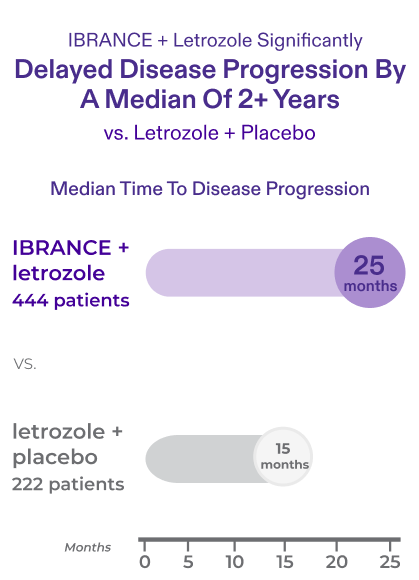
Together, the combination of IBRANCE and letrozole delayed disease progression for a median time of 25 months versus 15 months for those who received letrozole and placebo. Patients taking IBRANCE with letrozole reduced their risk of disease progression by 42% compared to those taking letrozole and placebo.
This means that IBRANCE plus letrozole was significantly more effective at delaying disease progression versus letrozole and placebo.
This clinical trial measured the total time patients lived from the start of treatment (overall survival). No significant difference in overall survival was observed between patients who had taken IBRANCE plus letrozole and those who had taken letrozole plus placebo.
-

- In the same clinical trial, tumor response to treatment was measured. The results showed that in patients taking IBRANCE and letrozole, tumor response was 55%—meaning more than half of these patients saw their tumors shrink in size—compared to 44% who took letrozole and placebo.
In combination with fulvestrant, IBRANCE is for adult patients with HR+/HER2- mBC who have previously received hormonal therapy for their disease.
IBRANCE was studied in a clinical trial of 521 women with HR+/HER2- metastatic breast cancer, regardless of their menopausal state, who had received hormone therapy either for early-stage breast cancer or for metastatic disease. Patients were split into 2 groups. The first group took IBRANCE and fulvestrant together, while the second group took fulvestrant and placebo.
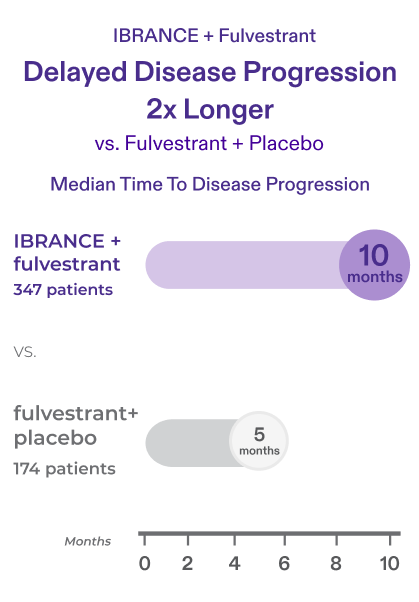
This means that IBRANCE plus fulvestrant was 2x more effective at delaying disease progression versus fulvestrant and placebo.
This clinical trial measured the total time patients lived from the start of treatment (overall survival). No significant difference in overall survival was observed between patients who had taken IBRANCE plus fulvestrant and those who had taken fulvestrant plus placebo.
-

- In the same clinical trial, tumor response to treatment was measured. The results showed that in patients taking IBRANCE and fulvestrant, tumor response was 24.6%—meaning 24.6% of these patients saw their tumors shrink in size—compared to 10.9% who took fulvestrant and placebo.
Side Effects
While on therapy, be sure to share any side effects you experience with your healthcare team right away.
SERIOUS SIDE EFFECTS
- Low white blood cell counts (neutropenia) are very common when taking IBRANCE (palbociclib) and may cause serious infections that can lead to death. Your healthcare team should check your white blood cell counts before and during treatment.
- If you develop low white blood cell counts during treatment with IBRANCE, your doctor may stop your treatment, decrease your dose, or may tell you to wait to begin your treatment cycle. Tell your doctor right away if you have signs and symptoms of low white blood cell counts or infections, such as fever and chills.
- Lung problems (pneumonitis). IBRANCE may cause severe inflammation of the lungs during treatment that can lead to death. Tell your doctor right away if you have any new or worsening symptoms, including:
- chest pain
- cough with or without mucus
- trouble breathing or shortness of breath
Your healthcare provider may interrupt or stop treatment with IBRANCE completely if your symptoms are severe.
THE MOST COMMON SIDE EFFECTS
- In addition to low white blood cell counts (neutropenia), low red blood cell counts and low platelet counts are common with IBRANCE. Call your healthcare team right away if you feel dizzy or weak, notice that you bleed or bruise more easily, or experience shortness of breath or nosebleeds while on treatment.
- Other most common side effects include:
- infections
- tiredness
- nausea
- sore mouth
- abnormalities in liver blood tests
- diarrhea
- hair thinning or hair loss
- increased blood creatinine
IBRANCE may cause fertility problems in males. This may affect your ability to father a child. Talk to your healthcare provider about family planning options before starting IBRANCE if this is a concern for you.
Tell your healthcare provider if you have any side effect that bothers you or that does not go away.
These are not all of the possible side effects of IBRANCE. Call your doctor for medical advice about side effects.
You are encouraged to report negative side effects of prescription drugs to the FDA. Visit www.fda.gov/medwatch or call 1-800-FDA-1088.
Please see additional Important Safety Information here.

