
What To Know About Your HR+/HER2- mBC Diagnosis
What Is Metastatic Breast Cancer (mBC)?
BREAST CANCER IS DESCRIBED in different stages. The stages are determined by the size of the tumor and if it has spread to a certain number of lymph nodes or other areas of the body.
Metastatic breast cancer, also known as stage IV breast cancer, can be any size and occurs when cancer has spread outside the breast and nearby lymph nodes to other parts of the body, such as the lungs, bones, liver, or brain.
How Is mBC Diagnosed?
Because mBC may impact different areas of the body, your healthcare team may use the following tests to confirm diagnosis of the disease:
- Blood tests that may detect any abnormalities
- Imaging tests, such as an MRI, PET/CT scan, bone scan, and x-ray
- A biopsy using tissue or fluid samples to confirm the presence of cancer
- Additional cancer lab tests to help determine the subtype of the cancer
Once a diagnosis of mBC is made, treatment is based on the specific test results and what your doctor determines is right for you.
There is currently no cure for metastatic breast cancer, but there are treatments that can shrink the cancer or slow its progress for some time.
Tips & Support
“What now?” That may have been one of your first thoughts after receiving an mBC diagnosis. Allowing yourself time to process the diagnosis and organize your thoughts is vital. If you’re feeling overwhelmed, there are steps you can take that may help.
Download the following Tips Sheet, which is designed to help support you as you manage your diagnosis:
Newly Diagnosed Tips Sheet
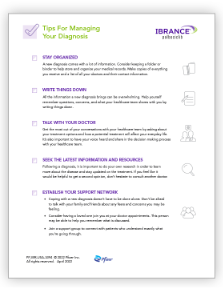
Tips and supportive resources you can print or email to yourself and loved ones.

“It is easy to lose yourself in a diagnosis like mBC. You need people to help you get through this difficult time.”
Chris, Ambassador
Hear The Stories Of Patients With mBC
Ambassadors were compensated for their time.
Hear The Stories Of Patients With mBC
Ambassadors were compensated for their time.
mBC Facts & Figures

Hormone receptor-positive (HR+), human epidermal growth factor receptor 2-negative (HER2-) is the most common subtype of metastatic breast cancer, representing roughly 70% of all cases.
While the majority of women with breast cancer are diagnosed at an early stage, in some, the cancer is only detected when it has already metastasized. Moreover, breast cancer may reoccur after treatment. Roughly 30% of women who’ve had breast cancer will develop metastatic breast cancer.


Talking With Friends And Family About Your Diagnosis
It’s understandable that those who care for you will also want to learn more about your diagnosis. Discussing your diagnosis with friends and family isn’t always easy, but it can be helpful—for you and for them.
It’s important to remember that your story is yours alone. How you choose to tell it is entirely up to you. Share as much or as little as you are comfortable with, and only as you see fit.
Additional insights and advice are available. See Tips On Living With mBC.
Newly Diagnosed FAQs
Hormone receptor-positive (HR+) is a subtype of breast cancer that includes both ER+ and/or PR+ subtypes and grows in response to two different hormones—estrogen and/or progesterone. If your cancer grows in response to the hormone estrogen, your cancer could also be called estrogen receptor-positive (ER+). If your cancer grows in response to the hormone progesterone, it could be called progesterone receptor-positive (PR+).
If your subtype is HER2-, your cancer cells have less HER2 protein expression and, therefore, are less likely to respond to anti-HER2 therapies.
A CDK4/6 inhibitor is a type of treatment that works to disrupt the activity of cell growth and division by preventing certain proteins (called CDK4 and CDK6) from telling the cell that it needs to grow and divide.
IBRANCE is in a class of drugs called CDK4/6 inhibitors that work to put the brakes on cell growth and division in both healthy and cancerous cells. This helps slow the progression of cancer, but it can also cause side effects, some of which are serious. Please see the Important Safety Information to learn more.

