

Taking IBRANCE For
HR+/HER2- mBC
Where Can I Get IBRANCE?
IBRANCE is available through Specialty Pharmacy Providers (SPPs). SPPs are pharmacies that handle medicines that are often not stocked at regular neighborhood pharmacies. Your healthcare team can help you find an SPP that works with your insurance.
SPPs also offer a number of additional services to you, including:
- Helping you navigate through the insurance system
- Answering financial questions about coverage
- Help identifying financial assistance resources if you are eligible
- Providing you with information about your medication
- Answering questions about side effects
Dosing
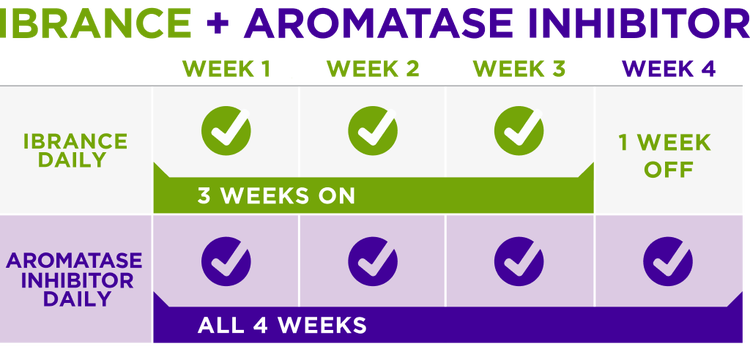
- IBRANCE and an aromatase inhibitor are taken orally in a 4-week cycle as a once-daily dose. For the first 3 weeks (21 days), you’ll take one IBRANCE and one aromatase inhibitor pill, once a day. Then for the last week (7 days), you’ll take only one pill, once a day—an aromatase inhibitor. At the end of 4 weeks, the cycle will start over again. Your healthcare team will monitor your therapy throughout.
-

Even though you’ll stop taking IBRANCE for the last week of each cycle, an aromatase inhibitor should be taken every day throughout your therapy. It should even be taken if your healthcare team stops your treatment with IBRANCE or adjusts your dose. But before making any changes, check with your healthcare team to make sure you’re taking your prescriptions correctly.
Dosing Tracker
-
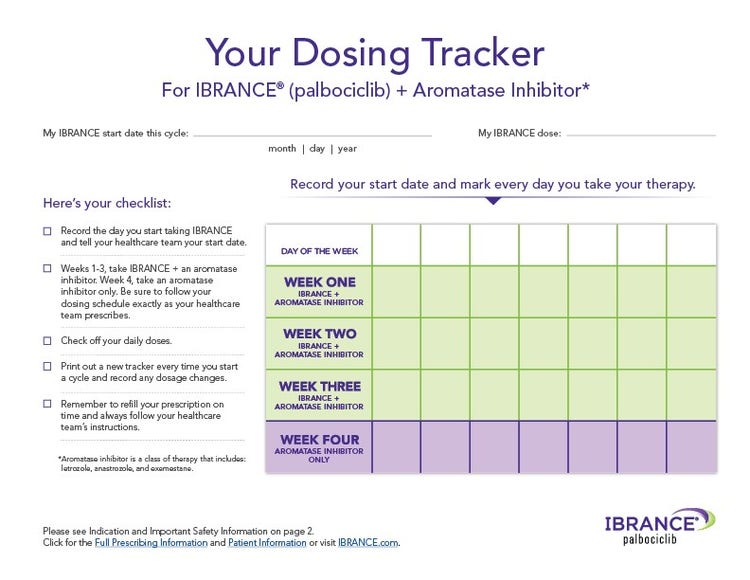
- Download this Dosing Tracker to keep track of when to take IBRANCE and an aromatase inhibitor.
- View Full Prescribing Information
- Download Tracker
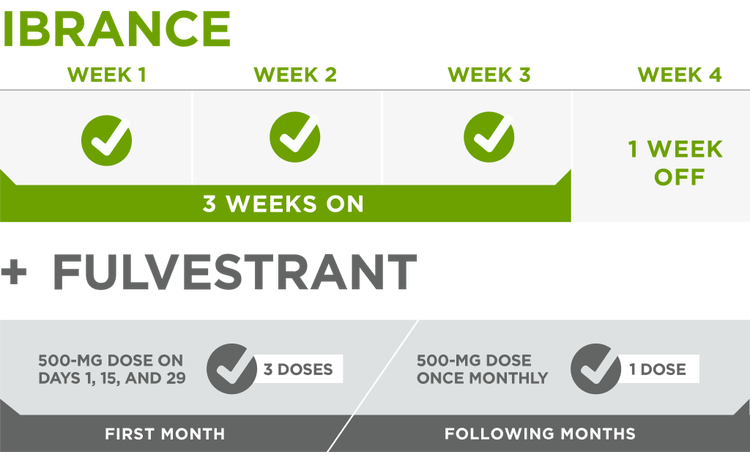
- IBRANCE is taken orally over a 4-week cycle as a once-daily dose. For the first 3 weeks (21 days), you’ll take one IBRANCE pill, once a day. Then for the last week (7 days), you won’t take IBRANCE. At the end of 4 weeks, the cycle will start over again. Your healthcare team will monitor your therapy throughout.
-
Fulvestrant is an intramuscular injection that is administered by your healthcare provider. Each treatment is given as 2 injections (for a 500-mg total dose). Fulvestrant requires 3 doses during the first month of treatment. Your healthcare provider will give you one dose on Days 1, 15, and 29 of the first month and then a single dose once a month thereafter. Please refer to the chart above, and be sure to discuss scheduling your injection appointments with your healthcare team.
Dosing Tracker
-
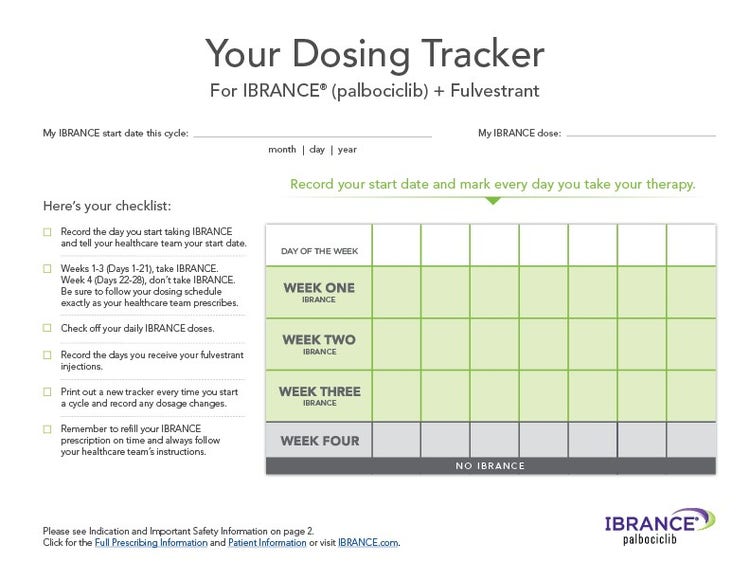
- Download this Dosing Tracker to keep track of when to take IBRANCE and fulvestrant.
- View Full Prescribing Information
- Download Tracker
What To Tell Your Doctor Before You Start
Your healthcare team will prescribe IBRANCE in combination with either an aromatase inhibitor or fulvestrant.
Before taking IBRANCE, it’s important to talk to your healthcare team about any health issues or other medications you’re taking, including prescription medicines, over-the-counter medicines, vitamins, and herbal supplements. IBRANCE and other medicines may affect each other and cause side effects. Know the medicines you take. Keep a list of them to show your healthcare provider or pharmacist when you get a new medicine.
Additionally, before you take IBRANCE, tell your doctor about all of your medical conditions, including if you:
- have fever, chills, or any other signs or symptoms of infection
- have liver or kidney problems
Tell your healthcare provider if you are pregnant or plan to become pregnant; IBRANCE can harm your unborn baby. Females who are able to become pregnant should use effective birth control during treatment and for at least 3 weeks after the last dose of IBRANCE. Your doctor may ask you to take a pregnancy test before you start treatment with IBRANCE. Males with female partners who can become pregnant should use effective birth control during treatment with IBRANCE for at least 3 months after the last dose of IBRANCE.
Tell your healthcare provider if you are breastfeeding or plan to breastfeed. It is not known if IBRANCE passes into your breast milk. Do not breastfeed during treatment with IBRANCE and for 3 weeks after the last dose.
Monitoring Considerations
To monitor side effects, your healthcare team will perform a blood test to check your complete blood cell count before starting IBRANCE and at the beginning of each cycle (month). For the first 2 cycles, you'll need a complete blood cell count on Day 15 as well. Make sure to tell your healthcare team which day you start your first and second cycles, so they can schedule your Day 15 appointment at the right time.
If your blood test results indicate low white blood cell counts (neutropenia), your healthcare team may temporarily hold or adjust your dose. It’s not uncommon to have doses modified throughout treatment. Be sure to follow your dosing schedule exactly as your healthcare team prescribes and talk to your doctor if you have any questions about monitoring.
Tips For Taking IBRANCE
How To Use Your Weekly IBRANCE Packs
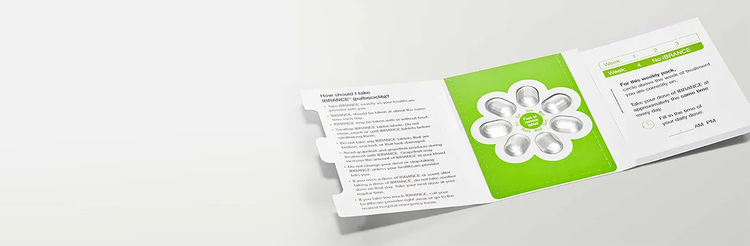
The packaging features a clear and simple design with helpful information on how to take once-daily IBRANCE throughout the 3-weeks on, 1-week off treatment schedule. Tablets must be kept in the pack until it is time to take them. Your monthly box will contain 3 individual weekly packs. Each pack contains 7 IBRANCE tablets. Watch the video below to learn more.
https://players.brightcove.net/1852113022001/JpBcT6sXX_default/index.html?videoId=6389751367112
Welcome to your IBRANCE® (palbociclib) tablets monthly box.
As you may already know, these smooth-coated tablets have the same active ingredient as the capsules, and are lactose and gelatin free. And, unlike the capsules, you can take IBRANCE tablets with or without food.
The tablets come in three dosage strengths: 125 mg, 100 mg, and 75 mg.
So your child-resistant blister packaging will come in the box that’s the dose strength prescribed for you. Inside every IBRANCE box, you’ll find: an insert, which summarizes the treatment instructions, and your three individual weekly packs of IBRANCE tablets to use throughout your treatment cycle. It’s important to use only one pack per week.
Each pack includes dosing instructions on the left, and a schedule tracker on the right.
Take one pack out of the box and circle “Week 1.” This will remind you to use this pack for the first week of your 4-week cycle.
Now circle "Week 2" and "Week 3" on the inside of the other two packs.
This will help you to be sure to use the right pack each week.
Remember, IBRANCE is taken for 3 weeks in a row, and during the 4th week of the cycle no IBRANCE is taken.
As always, follow your dosing schedule for IBRANCE and your combination treatment exactly as your healthcare team prescribes.
Start with the first pack during the first week, and with the tablet marked with the appropriate day of the week. Take one tablet of IBRANCE daily, at the same time every day, until the pack is finished.
Only store your IBRANCE tablets in the original blister packaging, and do not remove the tablet until it is time to take your dose.
Always swallow the tablets whole, and do not take any tablets that are broken or damaged.
To remove your IBRANCE tablets from the package, try one of these simple methods: Note, while packaging colors and tablet sizes may vary, these techniques will work for all of them.
Also, for all three techniques, make sure you hold your hands over a table.
Method One.
Unfold the blister pack.
Next, cup one hand and hold it under the tablet that you want to remove.
Using your opposite hand, place your thumb over the foil and push to release the tablet into your cupped hand.
If the tablet does not push all the way through, peel back the paper underneath.
Method Two.
Hold the center sleeve in both hands.
Find the tablet for the appropriate day of the week.
Apply equal pressure to the blister with both thumbs until the tablet is pushed through the foil.
Again, if the tablet does not push all the way through, just peel back the paper underneath.
Method Three.
Take two fingers and place them over the foil for the tablet that you wish to take, keeping your two thumbs underneath the blister pack.
Now, without letting go, flip the blister pack over so that your thumbs are now on top.
Apply equal pressure to the foil covering the tablet with your fingers and push the tablet up towards your thumbs.
And just like the last two methods, you can always peel back the paper if the tablet does not push all the way through.
If you have questions, speak with your healthcare provider or pharmacist.
Thanks for watching.

Patient Starter Kit
In your free patient starter kit, you’ll find the following resources to help support you through your treatment journey:
- Personal Journal: A place to write down your symptoms, questions, and concerns
- Patient Guide: In-depth treatment information and support resources
- Carrying Case: This case can be used for carrying an individual IBRANCE weekly pack with you
- Caregiver Guide: Guidance for caregivers to help support patients and themselves
Taking IBRANCE FAQs
IBRANCE is available in both capsules and tablets. There is no change to the active ingredient in IBRANCE or to the dosage strengths available (125 mg, 100 mg, 75 mg). Please note that the smooth-coated tablet may be taken with or without food for your convenience.
See below for notable differences between IBRANCE capsules and IBRANCE tablets.
- Capsule
-
-

-

-

-
- Must be taken with food hidden
- Contains lactose (dairy) and gelatin
- Gelatin-coated capsule
- Received in bottle; can be stored in bottle or pill caddy
-
- Tablet
-
-

-

-

-
- May be taken with or without food
- Does not contain lactose or gelatin
- Smooth-coated tablet
- Received in—and must be stored in—blister packs
-
Capsules and tablets shown above are not actual size.
- Take IBRANCE exactly as your healthcare provider tells you.
- IBRANCE tablets may be taken with or without food.
- IBRANCE capsules must be taken with food.
- IBRANCE should be taken at about the same time each day.
- Do not chew, crush, or split IBRANCE capsules or tablets before swallowing them. Take whole.
- Do not take any IBRANCE capsules or tablets that are broken, cracked, or that look damaged.
- Avoid grapefruit and grapefruit products during treatment with IBRANCE. Grapefruit may increase the amount of IBRANCE in your blood.
- Do not change your dose or stop taking IBRANCE unless your healthcare provider tells you.
- If you miss a dose of IBRANCE or vomit after taking a dose of IBRANCE, do not take another dose on that day. Take your next dose at your regular time.
- If you take too much IBRANCE, call your healthcare provider right away or go to the nearest hospital emergency room.
Store IBRANCE at 68° F to 77° F (20° C to 25° C).
Tablets must be stored in the original blister pack. Capsules may be stored in the bottle or a pill caddy.
Keep IBRANCE and all medicines out of the reach of children.

